How to Prepare for Your Next Diabetes Appointment Using Your CGM Data
A diabetes appointment is an important opportunity to review your progress, discuss concerns, and make sure your treatment plan continues to meet your needs. However, it can sometimes be difficult to remember everything you wanted to ask once the appointment begins.
Continuous Glucose Monitoring, commonly known as CGM, can make these conversations more informative by providing a broader picture of how your glucose levels change throughout the day and night.
Instead of relying only on individual glucose readings, CGM data can help you and your healthcare provider identify patterns related to meals, physical activity, sleep, medication, stress, and other parts of your daily routine.
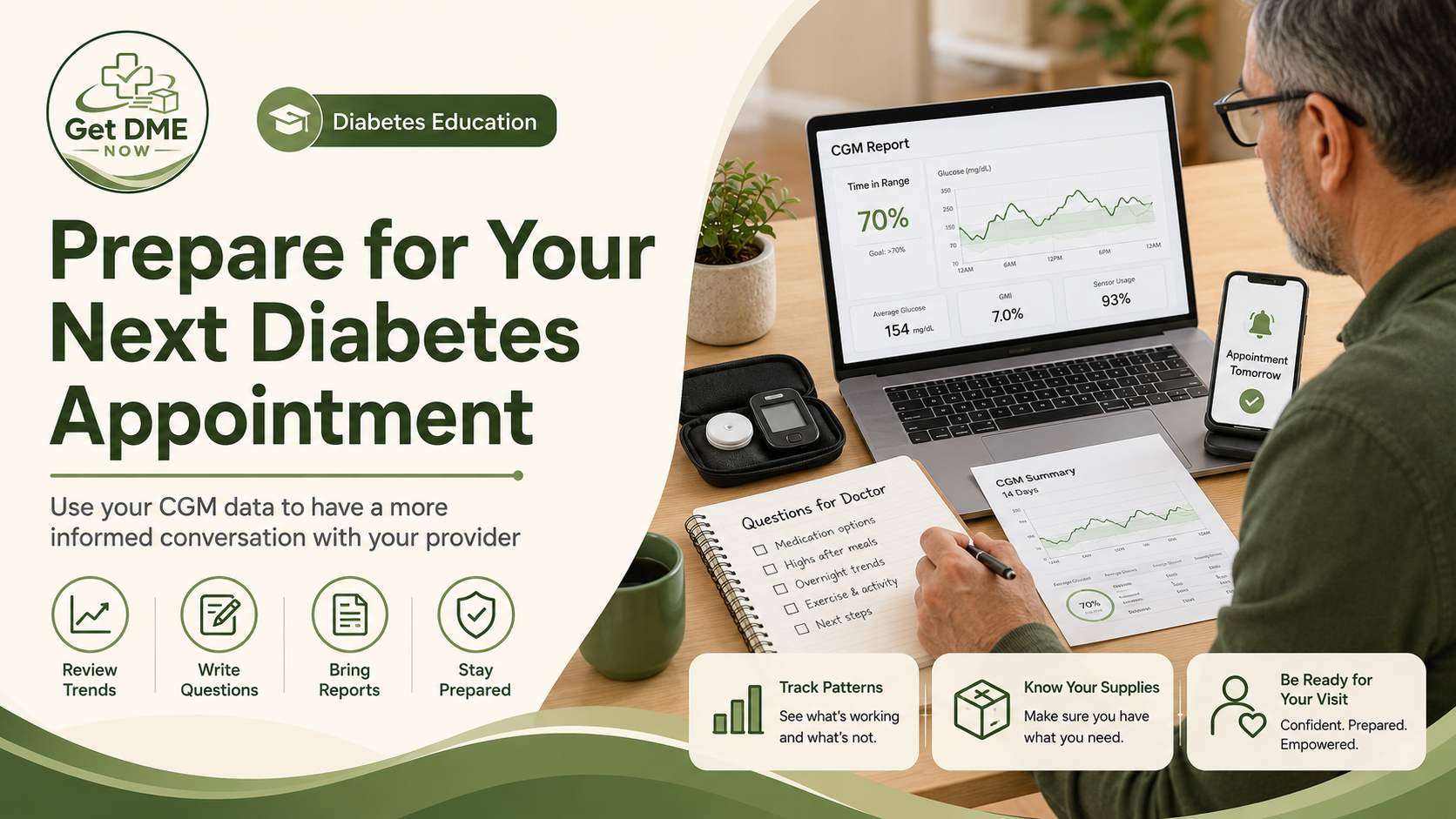
Preparing your information ahead of time can help you make the most of your appointment. Here are several practical steps you can take before meeting with your healthcare provider.
Why CGM Data Can Be Helpful During an Appointment
A traditional glucose reading shows what your glucose level was at one specific moment. CGM systems collect readings throughout the day and night, allowing users to see how their levels are changing over time.
Depending on the device and application being used, CGM reports may include:
- Average glucose levels
- Daily glucose graphs
- Glucose trends
- Time spent within a target range
- Time spent above or below a target range
- Estimated glucose management indicators
- Patterns that occur during certain times of the day
- Differences between weekdays and weekends
- Notifications for high or low readings
- Information about sensor use
This information does not replace the guidance of a qualified healthcare provider. However, it can help support a more detailed conversation about what may be happening between appointments.
1. Review Several Days or Weeks of Information
A single day may not represent your normal routine. Glucose levels can be affected by unusual meals, illness, stress, travel, changes in activity, missed medication, or poor sleep.
Before your appointment, review a wider period of information when possible. Many CGM applications allow users to view seven-day, fourteen-day, thirty-day, or longer reports.
Look for patterns rather than focusing only on one isolated reading.
You may notice that your glucose levels regularly:
- Rise after a particular meal
- Drop during or after physical activity
- Increase during the early morning
- Change during stressful periods
- Remain elevated overnight
- Fall at approximately the same time each day
- Respond differently on weekends
- Become less predictable when your schedule changes
Write down any patterns that appear repeatedly. These observations can help your healthcare provider understand what questions may need to be explored.
2. Pay Attention to Time in Range
Time in Range refers to the percentage of time your glucose levels remain within the target range recommended by your healthcare provider.
Your individual target range may be different from another person’s range. It can depend on factors such as your age, treatment plan, medications, overall health, and risk of low glucose.
Your CGM report may show:
- Time within your recommended range
- Time above your recommended range
- Time significantly above your recommended range
- Time below your recommended range
- Time significantly below your recommended range
Avoid changing medications or treatment decisions based only on the report. Instead, bring the information to your healthcare provider and ask what it means for your individual care plan.
Helpful questions may include:
- Is my current target range appropriate for me?
- Are there certain times when I am frequently outside my range?
- What patterns should I pay the most attention to?
- What should I do when I receive repeated high or low readings?
- Are my current goals realistic and safe?
3. Identify Repeated High or Low Patterns
One unusual reading does not always indicate a larger problem. Repeated readings at similar times may be more meaningful.
For example, you may notice that your glucose frequently rises after breakfast or decreases in the late afternoon. Another person may see changes overnight or after exercise.
When reviewing repeated patterns, make a note of:
- What time the change usually occurs
- Whether it happens before or after eating
- What foods were consumed
- Whether medication was taken as directed
- Whether physical activity occurred
- How well you slept
- Whether you were feeling stressed or unwell
- Whether the sensor appeared to be working normally
This context can help your healthcare provider determine whether the pattern may be related to your routine, medication timing, food choices, activity level, or another factor.
4. Review Your Meals and Daily Routine
Glucose levels are influenced by more than food alone. Your entire daily routine can affect your results.
Before your appointment, think about whether anything has recently changed, including:
- Meal timing
- Portion sizes
- Carbohydrate intake
- Physical activity
- Sleep schedule
- Work schedule
- Stress levels
- Medication timing
- Hydration
- Illness
- Travel
- Weight changes
You do not need to remember every detail from every day. A simple written summary can be enough.
For example:
“Glucose levels appear to rise most often after dinner.”
“Several low readings occurred after afternoon walks.”
“Morning readings have been higher since my sleep schedule changed.”
“My readings seem less predictable on weekends.”
These notes provide useful starting points for your appointment.
5. Keep a List of Questions
It is easy to forget questions during a medical appointment. Write them down in advance and bring the list with you.
Questions about CGM use may include:
- How should I respond to trend arrows?
- When should I confirm a CGM reading with a fingerstick?
- What should I do if my symptoms do not match the reading?
- How often should I review my reports?
- Which CGM measurements are most important for me?
- How should I handle repeated alerts?
- What can cause inaccurate or unusual readings?
- What should I do if a sensor falls off early?
- Can I change where I place the sensor?
- How should I prepare for travel?
- How often will I need replacement supplies?
Questions about your treatment plan may include:
- Are my current glucose goals appropriate?
- Should any part of my routine be adjusted?
- Are my medications working as expected?
- How may exercise affect my glucose?
- What should I do during illness?
- When should I contact the medical office?
- What symptoms require urgent medical attention?
Your healthcare provider can help determine which recommendations are appropriate for your specific situation.
6. Bring an Updated Medication and Supply List
Create a current list of all medications, supplements, monitoring equipment, and diabetes supplies you use.
Include:
- Medication names
- Dosages
- The time each medication is taken
- Insulin information when applicable
- Vitamins and supplements
- Your CGM system
- Glucose meter information
- Testing supplies
- Any other durable medical equipment
Also note whether you are having difficulty obtaining, using, storing, or replacing any supplies.
Let your healthcare provider know if:
- You are running low on sensors
- Your prescription is expiring
- Your insurance has changed
- A shipment was delayed
- You are experiencing sensor irritation
- Your device is frequently disconnecting
- Your equipment is damaged
- You are unsure when supplies should be replaced
Addressing these concerns during the appointment may help prevent interruptions later.
7. Download or Share Your CGM Report
Many CGM systems allow users to download, print, or electronically share reports.
Before your appointment:
- Open the application connected to your CGM.
- Look for a reports, history, sharing, or data section.
- Select the timeframe requested by your healthcare provider.
- Download, print, or share the report.
- Confirm that the medical office received access when electronic sharing is used.
The exact process varies by device. The device manufacturer, healthcare provider, or medical equipment supplier may be able to provide general assistance.
Do not wait until the appointment begins to look for your login information. Check your account in advance and make sure you remember your password.
8. Check Your Equipment Before the Visit
Your appointment is also an opportunity to discuss whether your current equipment is working properly.
Before the visit, inspect your supplies and make a note of any problems.
Consider whether:
- The sensor stays attached for the expected wear period
- Readings are consistently available
- Alerts are working correctly
- The receiver or smartphone remains connected
- The application is updating properly
- You understand how to insert and activate a new sensor
- You have enough supplies until your next shipment
- You know who to contact if equipment fails
Bring your receiver, reader, or smartphone when appropriate. Your healthcare provider may want to review your settings or reports with you.
9. Be Honest About Challenges
Diabetes management can be complicated. There may be days when routines are difficult to follow, medications are missed, meals are unpredictable, or monitoring feels overwhelming.
Your healthcare provider needs accurate information to make appropriate recommendations. Being honest about challenges can lead to more practical support.
You may want to discuss:
- Difficulty remembering medications
- Concerns about low glucose
- Trouble understanding CGM alerts
- Discomfort wearing a sensor
- Anxiety about glucose readings
- Problems accessing healthy food
- Difficulty affording or obtaining supplies
- Changes in work, school, or family responsibilities
- Feeling overwhelmed by diabetes management
These concerns are important parts of your care and should not be ignored.
10. Create a Follow-Up Plan Before You Leave
Before the appointment ends, make sure you understand the next steps.
Ask your healthcare provider to clarify:
- Whether your treatment plan is changing
- Which glucose patterns you should monitor
- When you should contact the office
- When your next appointment should be scheduled
- Whether laboratory testing is needed
- Whether prescriptions need to be renewed
- Whether updated documentation is required
- Whether you need a referral
- How future CGM reports should be shared
Write down the instructions or request a printed visit summary.
How Get DME Now Can Help
Managing diabetes supplies should not create unnecessary stress.
Get DME Now helps eligible patients access Continuous Glucose Monitors, diabetes supplies, and other types of durable medical equipment through their insurance benefits.
Our team can assist with:
- Reviewing insurance eligibility
- Verifying available benefits
- Coordinating with healthcare providers
- Requesting prescriptions and medical documentation
- Assisting with insurance requirements
- Arranging convenient delivery
- Helping patients understand the supply process
- Providing support when replacement supplies are needed
Many eligible patients may qualify for covered equipment with little or no out-of-pocket cost. Coverage, eligibility, copayments, deductibles, and documentation requirements vary by insurance plan.
Our team reviews available benefits and explains any known patient responsibility before an order is completed.
Make Your Next Appointment More Productive
Your CGM provides more than individual glucose readings. It can help reveal patterns that may be useful when discussing your health with your healthcare provider.
Before your next appointment, take a few minutes to review your reports, identify recurring patterns, write down your questions, and organize your medication and supply information.
A little preparation can lead to a more focused conversation and help you leave the appointment with a clearer understanding of your next steps.
To learn whether you may qualify for a Continuous Glucose Monitor or other durable medical equipment through insurance, visit GetDMENow.com and complete an eligibility request.
This article is provided for general educational purposes only and is not intended to diagnose, treat, cure, or prevent any medical condition. It does not replace advice from a qualified healthcare professional. Always speak with your healthcare provider before changing medications, treatment plans, glucose targets, or monitoring routines.